SE Timely and Accurate Reporting (Indicator 20)
Timely and Accurate Reporting
Federal Requirements
The Office of Special Education Programs (OSEP) administers the Individuals with Disabilities Education Act (IDEA) which is designed to improve outcomes for children with disabilities, birth through 21, and their families, ensuring access to fair, equitable and high-quality education services.
IDEA requires each state to develop a State Performance Plan/ Annual Performance Report (SPP/APR) that evaluates Georgia’s efforts to implement the requirements and purposes of the IDEA. It also includes descriptions of how the GA Department of Exceptional Children (DEC) will improve its implementation. Georgia is required to submit a state performance plan (SPP) at least every six years. Annually, Georgia must report against the targets in the SPP in an annual performance report (APR).
OSEP expects Georgia to have a data system that is reasonably designed to collect and report valid and reliable IDEA Part B Section 616 and Section 618 data to the Department and the public in a timely manner. Thus, Georgia’s Department of Education (GaDOE) has implemented a dynamic system with checks and balances to ensure quality data is submitted by both the LEA and SEA. The GO-IEP system, the SE Application Dashboard and the GaDOE web portal applications interact to provide a seamless and robust data reporting system.
“Timely and accurate data” refers to a system or process that ensures data is collected, updated, and readily available at the right time, while also maintaining an elevated level of correctness and reliability. There are four key components:
- Real-time or near real-time updates: Data is captured and refreshed to minimize delays and reflect current conditions.
- Automated data collection: Utilizing technology to automatically gather data from reliable sources, reducing manual entry errors and improving speed.
- Data validation processes: Implementing checks and balances to identify and correct inaccurate data entries during collection and before analysis.
- Data governance framework: Establishing clear guidelines for data management, including access control, data quality standards, and data ownership.
Annually, each LEA is rated on their timely and accurate data submissions in the Special Education (SE) Timely and Accurate Data Application. These are LEA determinations, not just special education determinations. Some applications include special education information but are not submitted by special education administrators.
The data for this application is populated by GaDOE and comes from a variety of sources including FTE, Student Class, CPI, Student Record, the Consolidated Application, Cross Functional Monitoring, and specialized data collections such as Post School Outcomes, Preschool Exit Data, Timelines and Continuation of Services.
SE Directors submit Cross Functional Monitoring, Post School Outcomes, Transition Planning, Preschool Exit Data, Timelines and Continuation of Services in the SE Applications Dashboard annually. The SE Directors also submit the IDEA 619 and 611 budgets in the GaDOE web portal. For the other submissions, FTE, CPI, Student Class and Student Record, the Special Education data is part of the larger LEA data collection. Often other LEA personnel are involved. It is important that the Special Education Director communicates with personnel submitting the data to ensure timely and accurate submissions. GaDOE provides a yearly calendar with the due dates for all data submissions.
Below is the current list of data submissions that impact the LEA’s Timely and Accurate data score:
- CEIS Plan
- Consolidated Application
- IDEA PreK (619)
- IDEA Flow Through (611)
- Continuation of Services
- CPI-1
- Excess Cost
- FTE-1
- Post School Outcomes
- Preschool Exit Data
- Student Class
- Student Record
- Timelines
- Transition Planning
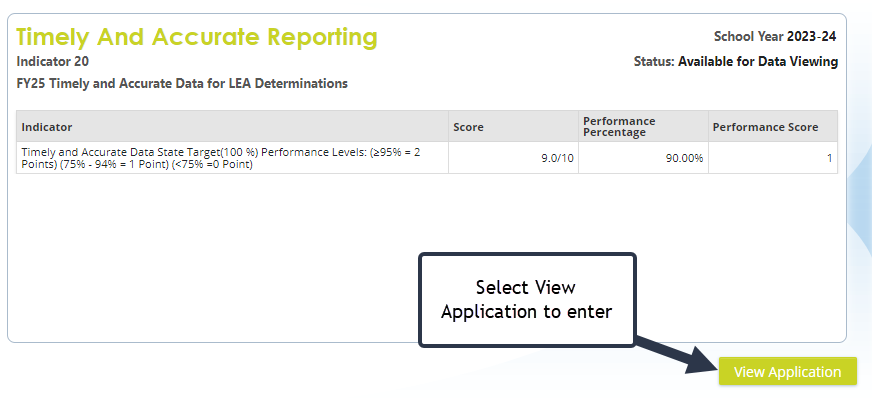
Timely and Accurate Reporting
Screenshot of Timely and Accurate Reporting tile
After entering the application, the table shows each data submission from the previous year and whether the LEA submitted it in a timely and accurate manner.
Screenshot of the landing page for Timely and Accurate Reporting
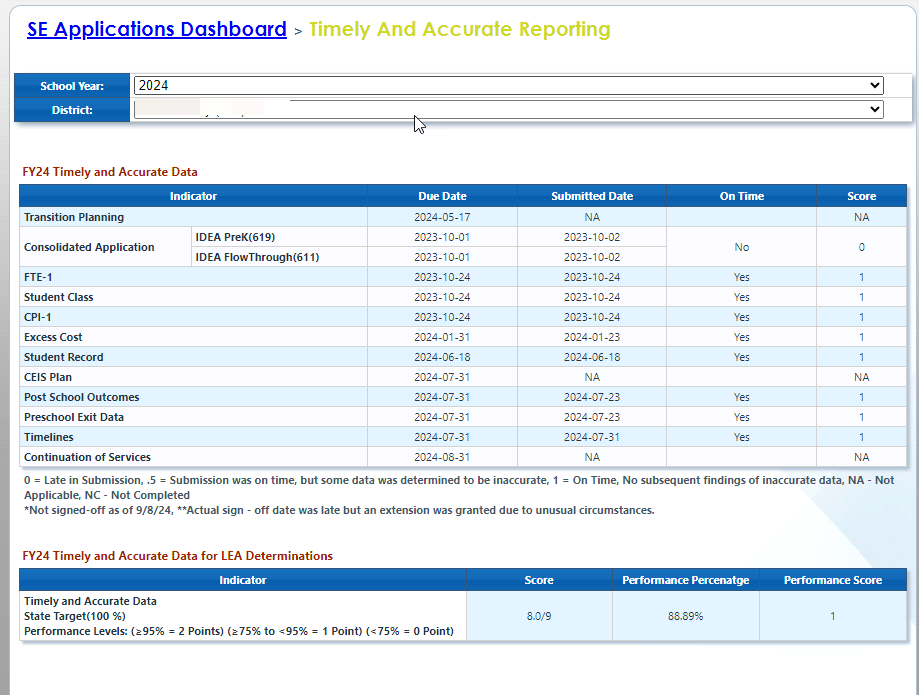
LEAs are rated on their timely and accurate data submissions. The state target is 100%. LEAs earn points for each submission:
1 = On Time, No subsequent findings of inaccurate data,
.5 = Submission was on time, but some data was determined to be inaccurate
0 = Late Submission
The total score is calculated using all data submission categories applicable to the LEA as the denominator. For example, a Charter LEA may only serve students in grades K-5. Therefore, the Post School Outcomes survey is not applicable. As a result, the LEA’s score for Post School Outcomes will show as NA, and the denominator in the Timely and Accurate calculation will not include that application.
If one or more errors are found after a LEA submits the data, the LEA will lose .5 of the point for their inaccurate submission of data in that report.
Each LEA’s score is calculated by totaling the points earned and dividing that by the count of applications applicable to that LEA. A performance percentage is displayed. Then the performance percentages are converted into a performance score for Timely and Accurate.
- ≥95% = 2 points
- ≥75% to <95% = 1 point
- <75% = 0 point
Under the grid with the timely and accurate score rating for each application, a field is displayed showing the Score, Performance Percentage, and Performance Score for Timely and Accurate which will be included in the LEA’s District Determination.

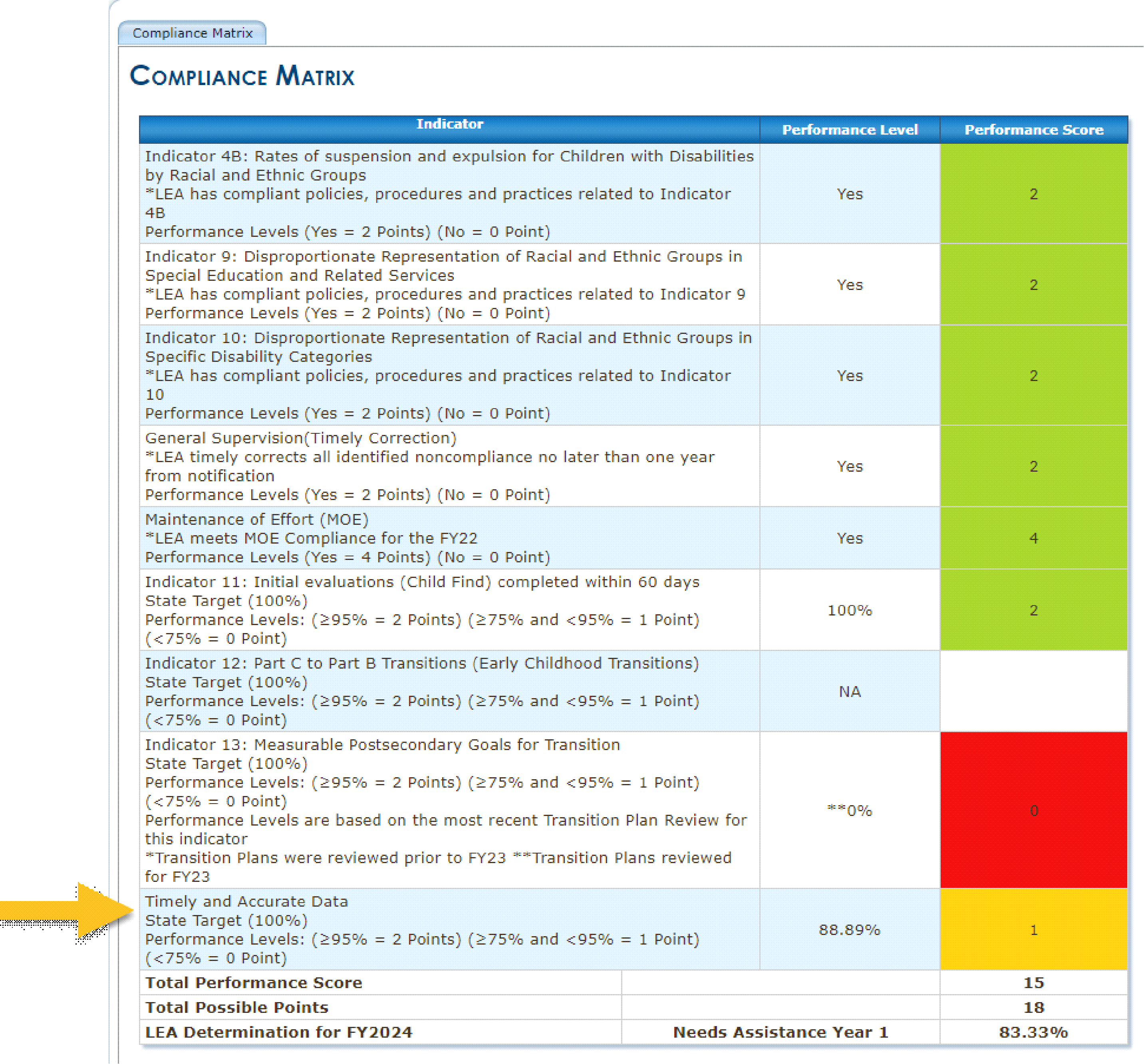
Each LEA receives an annual determination on the implementation of IDEA based on data reported by the LEA, information obtained through monitoring visits, and any other public information. GaDOE will determine if each LEA: Meets Requirements; Needs Assistance; Needs Intervention; or Needs Substantial Intervention. District Determination is a compliance matrix with nine indicators. Each indicator has a point value. Timely and Accurate Reporting is one of the nine indicators.
Screenshot of a LEA’s Determination